
Getting PR packages isn't just for influencers. For those in the "make money online" space, there's a huge, often-overlooked opportunity to work with creators, managing the very process that lands these brand deals. This is a real business opportunity focused on social media and email management.
The job is straightforward: you partner with a content creator, build a professional outreach system, and start pitching brands on their behalf. You'll be the one handling the inbox, coordinating logistics, and turning a creator's online presence into a revenue-generating machine.
Your Inroad to Managing Creator Brand Deals

While most guides focus on the person in front of the camera, the real strategy and income potential often lie with the person managing their business operations. This guide is your entry point into a unique online career: becoming the go-to manager who knows exactly how do you get pr packages for content creators.
Instead of building your own massive following, you'll be building a service-based business that helps creators monetize theirs through brand partnerships.
If you have strong organizational and communication skills, this role is a perfect fit. You become the critical link between a talented creator and the brands eager to connect with their audience, offering valuable social media and email management services.
So, What's the Manager's Job, Really?
Your primary role is to run the business side of a creator's brand. This frees up the influencer to focus on what they excel at—creating compelling content that grows their audience.
For many creators, especially those gaining traction, their inbox is a chaotic mix of legitimate offers, spam, and fan mail. It's overwhelming. They need a professional to filter the noise, negotiate favorable terms, and maintain strong brand relationships.
That’s where you come in and provide tangible value. Your day-to-day responsibilities will include:
- Brand Scouting: Proactively identifying companies that align perfectly with your creator's niche and audience.
- Pitch Crafting: Developing compelling emails and customized media kits that capture a brand's attention and lead to conversations.
- Communication Hub: Managing all back-and-forth with PR agencies and brand representatives, from the initial outreach to the final campaign report.
- Logistics Coordination: Ensuring PR packages are sent to the correct address and that the creator understands the deliverables and deadlines.
A great manager doesn't just wait for opportunities. They build a systematic process for outreach that turns a creator's influence into a consistent stream of brand collaborations and income.
By taking on these tasks, you're not just an assistant; you are a strategic business partner actively growing the creator's revenue. In this guide, we’ll walk through the exact steps to build this career for yourself, starting with establishing your professional presence and landing your first clients.
Building Your Foundation as a Creator Manager

Before diving into the mechanics of securing PR packages, you need to build a professional foundation that makes creators trust you with their brand. Your first move isn't pitching brands—it's proving to potential creator clients that you are a serious, capable manager who can help them grow their business.
Think of yourself as the architect of their brand partnership strategy. You’re the operational arm that handles all the social media management and email outreach, freeing them up to focus on what they do best: creating.
Define Your Niche and Services
You can't be everything to everyone, and trying to be is a fast track to burnout. The most successful managers start by choosing a specific niche. This focus allows you to become a true expert in one area, making you a highly attractive partner for creators in that community.
For instance, instead of being a generic "creator manager," you could specialize.
- Beauty Micro-Influencers: You could be the go-to manager for creators with 5,000-50,000 followers in the skincare and makeup world.
- Twitch Streamers: Maybe you're passionate about gaming. You could manage outreach for up-and-coming streamers looking for tech and snack brand sponsors.
- Food Bloggers: Or you could partner with culinary creators who want to work with kitchenware and gourmet food brands.
Once you’ve zeroed in on your niche, map out your services. This isn't just a list of tasks; it’s a clear summary of the value you provide. Your core offerings should directly address a creator's biggest pain points, such as a disorganized inbox or missed opportunities.
Your service menu is your promise. It needs to show a creator exactly how you'll save them time, secure better opportunities, and bring order to their chaotic inbox. The end goal is always more brand deals and PR packages.
You could offer an "Inbox & Email Management" package, where you handle all incoming inquiries and weed out the noise. A more comprehensive option might be a "Full-Service Brand Outreach" package. This tiered approach is standard practice, which you can see by looking at how various OnlyFans agencies structure their offerings for creators.
Build Your Professional Toolkit
Okay, you've got your niche and services figured out. Now it's time to assemble your professional toolkit. These are the non-negotiables that show creators you’re a legitimate business partner, not just a fan with a good idea.
First things first, get a professional email address. An address like yourname@creatormanagement.com carries so much more weight than a generic Gmail account. It's a small detail that makes a massive difference in perception.
Next up, create a simple one-page website or a digital portfolio. This is your digital business card. It needs to clearly present who you are, the niche you serve, your service packages, and an easy way to get in touch.
Finally, have a basic client agreement or contract template ready to go. This document is crucial because it protects both you and the creator by outlining expectations, deliverables, and payment terms right from the start. Having this prepared shows you’re a pro and helps build the trust you need to land that first client.
How to Find and Partner With the Right Creators

As a manager, your success is completely tied to the talent you represent. While it’s tempting to target creators with massive followings, they almost always have a team. Your real opportunity—your sweet spot—is in identifying rising stars who need your social media and email management skills.
I'm talking about those creators with incredible potential who just don't have the time or know-how for brand outreach. They're the ones who need you most.
You're not just looking for someone who makes good content; you're looking for a solid business partner. The ideal creator has a defined niche, a genuinely engaged audience, and a professional mindset. They might be a genius at creating viral videos but feel totally swamped by their inbox. That's where you come in.
Where to Discover Untapped Talent
Finding these hidden gems takes a bit of digital detective work. Your mission is to spot creators right before they blow up, before every other manager is sliding into their DMs. I've found the best places to look are the platforms where visual storytelling really shines.
Here are a few proven spots to start your search:
- TikTok's "For You" Page: Don't just scroll mindlessly. Intentionally engage with content in the niches you want to work in. Soon enough, the algorithm will start feeding you creators who are gaining serious traction but haven't signed with anyone yet. I usually look for consistent high engagement on videos from accounts with under 50,000 followers.
- Instagram Hashtags & Reels: Get super specific here. Instead of just #beauty, search for things like #veganbeautyblogger or #indiegamedev. This is how you find creators with tight-knit communities. A quick scan of their bio is revealing—if there's no business email or "managed by" credit, they're a great potential lead.
- YouTube's "New to you" Tab: This feature is gold for finding channels that are growing but still flying under the radar. Look for creators who post consistently, have decent production quality, and actually take the time to respond to comments. That's a sign they care.
The media world is shifting under our feet. Getting PR packages isn't what it used to be; brands are now overwhelmingly digital-first, and influencers are the new gatekeepers. As old-school media's influence wanes, creators have become the go-to for press and product dissemination. You can get a deeper sense of this evolving media landscape from Ronn Torossian's update.
Assessing a Creator's Partnership Potential
Once you've spotted a creator who looks promising, it's time to do your homework. You need to see if they're truly ready to level up their business. A creator with a professional bio, consistent branding across their socials, and a clear call-to-action is probably already thinking about how to make money.
Before you even dream of pitching your services, dig into their content. Does it naturally fit the kinds of brands you have connections with? A creator producing high-quality, brand-safe content is infinitely easier to pitch to PR agencies.
Don't just look at the vanity metrics. Check their engagement rates, and I mean the real ones. Go beyond likes and look at the quality of the comments. Is the community active and supportive? That authentic engagement is what brands are actually paying for when they send out a PR package.
Finally, break the ice. Send a casual, complimentary message to test their professionalism and how responsive they are. Something as simple as, "Hey, I absolutely loved your recent video on X!" can open the door to a much bigger conversation. Your first move is about building a relationship, not making a hard sell.
Crafting the Perfect Brand Pitch for Your Clients
So, you’ve signed a new creator to your roster. Great. Now the real work begins. Your most critical job is mastering the art of the pitch. We're talking about crafting outreach emails and media kits that don't just get opened—they get a "yes." This is where you, as a manager, really prove your worth, turning your client's influence into solid brand partnerships and coveted PR packages.
The objective here isn't just to blast out emails. It's to start genuine conversations. A generic, copy-paste email is the fastest ticket to the trash folder. Every single pitch needs to feel like a unique proposal, showing you’ve done your homework and actually believe this partnership makes sense.
What Brands Actually Want to See
Your most powerful weapon in this process is a professional media kit. Think of it as your creator's resume; it has to tell a powerful story in just a few seconds. Forget the fluffy metrics and vanity numbers. Brands need to see hard data that justifies their investment, even if it's just for a gifted collaboration.
Here’s what your media kit absolutely must include:
- Verified Engagement Rates: Don't just list follower counts—they mean very little on their own. Instead, showcase the percentage of the audience that actively likes, comments, and shares content. An engagement rate of 3-5% on Instagram is often seen as strong and is way more valuable to a brand than a million passive followers.
- Audience Demographics: Brands need to know exactly who you're reaching. Include solid data on your creator's audience, covering age, gender, and top geographic locations. This is how a brand can immediately see if your client’s audience lines up with their target customer.
- Past Collaboration Case Studies: Nothing speaks louder than results. Feature one or two examples of successful past partnerships. Show the content that was created and highlight key results, like impressive engagement numbers or overwhelmingly positive audience feedback. This provides crucial social proof and shows you have a track record of success.
This flow chart breaks down the fundamental steps for securing PR packages: it all starts with solid research, moves to personalized outreach, and depends on diligent follow-up.
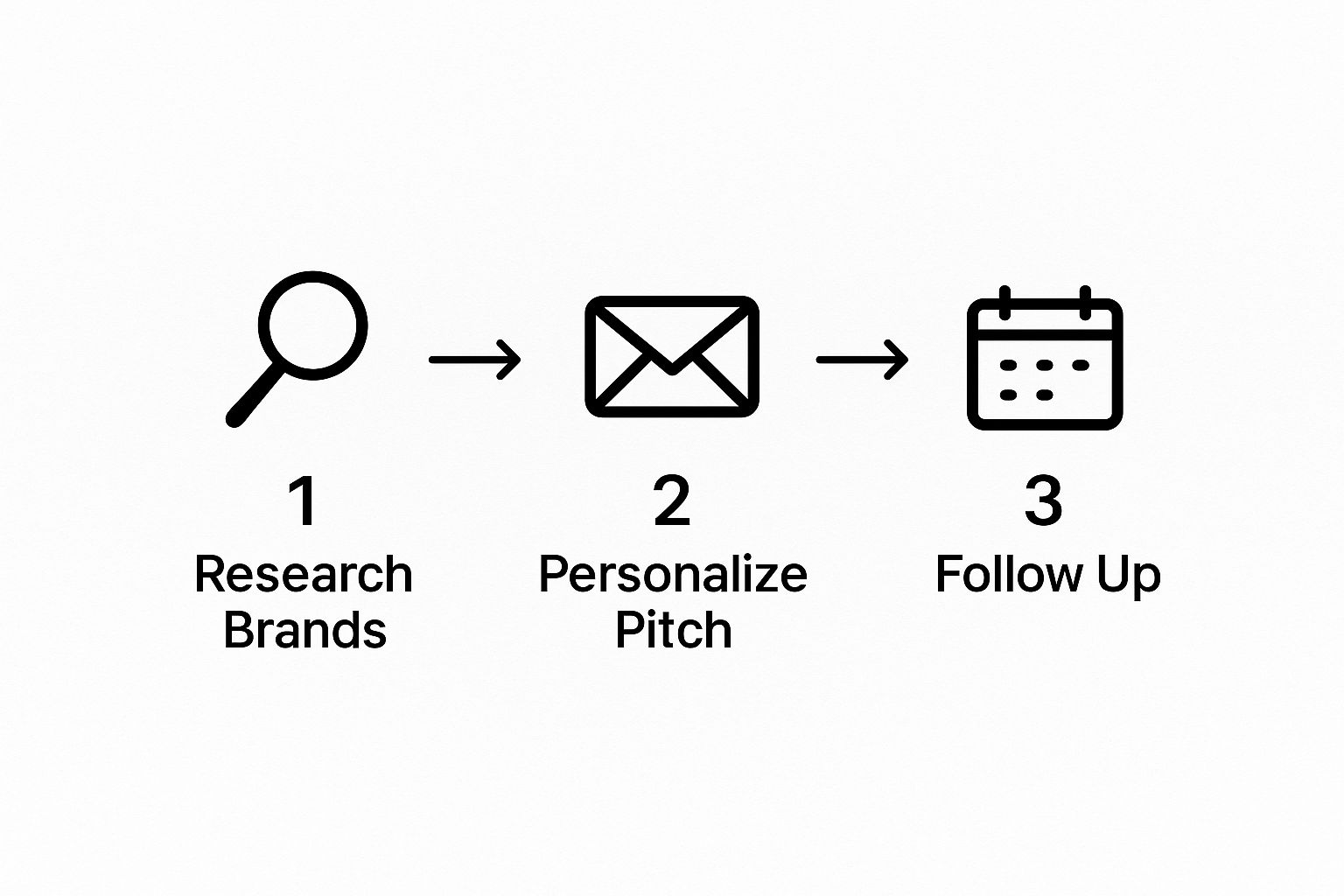
As you can see, landing these partnerships is a structured process, not just a game of luck. Each stage builds on the last, systematically increasing your odds of getting that "yes."
How to Write a Pitch That Brands Can't Ignore
The email itself is where you connect the dots for the brand. It needs to be concise, compelling, and centered on what they get out of the deal. I’ve seen thousands of pitches, and the ones that work always follow a similar structure.
Here's a simple breakdown of what a winning pitch email looks like:
| Anatomy of a Winning Brand Pitch Email |
| :— | :— | :— |
| Email Section | Purpose | Example Snippet |
| Compelling Subject Line | Grab attention in a crowded inbox. Make it personal and specific. | "Collaboration Idea: [Creator's Name] x [Brand Name]" or "Your new [Product Name] is perfect for our audience." |
| Personalized Introduction | Show you've done your research. Mention something specific about the brand. | "Hi [Contact Name], I've been a huge fan of [Brand Name]'s commitment to sustainability and loved your recent [Campaign/Product] launch." |
| The Value Proposition | Clearly state why this partnership makes sense for them. What problem do you solve? | "Our audience of [demographic] consistently asks for recommendations on [product category], and your new line is a perfect fit." |
| Introduce the Creator | Briefly introduce your client, highlighting key stats from the media kit. | "[Creator's Name] has built an engaged community of 50,000 followers with an average engagement rate of 4.5%." |
| The 'Ask' / Call to Action | Be clear about what you want. A call? A gifted product? A paid post? | "We'd love to discuss a potential partnership. Are you open to a brief chat next week? The media kit is attached for your review." |
A great pitch is a conversation starter. It’s not just a request; it's a proposal that presents a clear win-win scenario.
Finding the Right Contact and Following Up
Finding the right person to email is easily half the battle. Sending your carefully crafted pitch to a generic info@brand.com address is like throwing it into a black hole. Your best bet is to head over to a platform like LinkedIn and search for titles like "PR Manager," "Influencer Coordinator," or "Brand Partnerships Manager." These are the people whose job it is to find creators like yours.
Your follow-up game is just as important as your initial pitch. Let’s be real—people are busy, and inboxes are chaotic. A single, polite follow-up email sent 3-5 business days after your first one can dramatically increase your chances of getting a response.
A great follow-up isn’t pushy. It’s a gentle nudge that repositions your creator as a valuable partner. You could mention a recent successful post or a new creative idea you had for their brand.
The competition for brand attention is fierce. While press releases are still a go-to tool for many businesses, data for 2025 shows that only about 2-3% of them ever lead to actual media coverage. That tells you just how hard it is to cut through the noise. Your personalized pitch needs to be just as sharp, if not sharper, to get noticed.
By combining a data-rich media kit with targeted, persistent, and personalized outreach, you build a system that consistently lands opportunities. For more strategies on getting your clients noticed, you can learn more about how to get on PR lists in our detailed guide. This is the playbook for turning cold outreach into warm, long-term brand partnerships for your clients.
Using Modern Tools for Efficient Brand Outreach
Let's be honest: managing outreach for just one creator can feel like a full-time job. Juggling it for a whole roster of clients? That’s a different beast entirely. If you want to scale your management business and effectively get PR packages for everyone you represent, you have to ditch the spreadsheets and manual tracking. It’s just not sustainable.
The right tools aren't just about saving time—they make you a better, more strategic manager. They let you see every conversation, keep your contacts organized, and uncover new brand opportunities with a level of precision you just can't get from a spreadsheet. This is how you handle a growing client list without letting the quality of your work slip.
Leveraging Influencer Marketing Platforms
Think of influencer marketing platforms as specialized marketplaces where brands are already in a shopping mindset. Instead of you having to knock on every door, platforms like Aspire, Upfluence, and Grin bring the opportunities directly to you. These sites are constantly buzzing with brands ready to launch both gifted and paid campaigns.
Getting a solid profile set up for each of your creators on these platforms is absolutely non-negotiable. It puts them right in front of the PR managers and marketers who have a budget and are actively looking for talent. Your role instantly shifts from being just a hunter of opportunities to a manager of inbound interest, which is a much better position to be in.
When you build a strong presence on these platforms, you're essentially creating an automated lead-gen machine. Brands can find, vet, and reach out to your clients, often resulting in much warmer, higher-quality partnerships than cold outreach ever could.
The way brands get the word out has changed so much. It wasn't that long ago that press releases were sent by fax. Now, it’s a high-tech digital operation. Big newswire services like PR Newswire and Business Wire are how major companies blast their announcements across the globe, and this system is increasingly tied into how they find influencers. You can dig deeper into these public relations statistics and trends at PR Lab.
Adopting a Simple CRM for Outreach
The term CRM, or Customer Relationship Management, can sound a little corporate and intimidating, but it doesn't have to be. For a manager like you, a simple CRM is just a supercharged contact list and deal tracker. You can easily customize tools like HubSpot's free CRM, Trello, or even Notion to handle your entire outreach pipeline from start to finish.
Picture this: you're managing five creators and pitching 20 brands for each one. That's 100 different conversations happening at once. A simple CRM helps you keep it all straight.
- Track Every Pitch: You can log every single email you send, every follow-up, and every response for each creator and brand combo. Nothing falls through the cracks.
- Manage Contacts: It gives you a clean, organized record of every PR manager’s contact details and a history of your interactions with them.
- Set Reminders: This is a lifesaver. A CRM can automatically remind you to follow up, so you never miss an opportunity because you got too busy.
The Power of Multimedia in Your Pitch
Finally, never, ever underestimate the punch that multimedia can add to your pitch. An email with a link to a slick, 30-second sizzle reel showing off your creator's best work is infinitely more powerful than a wall of text. It's immediate, undeniable proof of their talent, personality, and content quality.
This one small addition can dramatically boost your response rates because it makes the PR manager's job easier. They don't have to go digging through an Instagram feed to see if your creator is a fit; you’ve handed them the "wow" factor on a silver platter, right in their inbox. Using tech to streamline your workflow and make your pitches pop is truly the secret to scaling your management business without losing your mind.
Common Questions for Aspiring Creator Managers
Jumping into the world of creator management is exciting, but let's be real—it can also feel like you're trying to assemble a puzzle without the box. You've got the basics down on finding creators and pitching, but those nagging, practical questions always pop up right when you're ready to start.
This is where we get into the nitty-gritty. Think of this as a chat with a seasoned manager, getting you the straightforward answers you need to move forward with confidence.
How Should I Price My Management Services?
Figuring out what to charge is probably the biggest headache for new managers. There’s no magic number, but the goal is to find a sweet spot that reflects your value without being out of reach for the creators you want to help.
You’ve basically got three solid models to work with, and you can adapt them as you go.
-
The Monthly Retainer: This is your bread and butter. You charge a flat fee every month for ongoing work like managing an inbox, vetting deals, and doing consistent outreach. This model is perfect for creators who already have a decent flow of inquiries, and it gives you a predictable income. A good starting point can be anywhere from $200 to over $1,000, depending on the creator’s size and how much you’re doing for them.
-
The Commission Split: This is the classic "eat what you kill" model. You take a percentage of the deals you close, which is a powerful motivator. A 10% to 20% commission is pretty standard in the industry. It's a great option for hungry managers and creators who want a low-risk, high-reward partnership.
-
The Hybrid Model: Why not have the best of both worlds? Many managers charge a smaller monthly retainer to cover their base time and effort, plus a commission on any paid deals they land. This gives you stability while still rewarding you for knocking it out of the park.
And what about gifted PR packages? For those, you can either roll that service into your monthly retainer or charge a small, flat fee for each package you successfully secure.
What Metrics Do Brands Actually Care About?
A massive follower count might look good on the surface, but smart brands know that's just a vanity metric. They’re digging deeper to see if a creator really has influence. When you're putting together a media kit, you need to highlight the numbers that prove there's a real, breathing community there.
Here’s what brands are laser-focused on:
- Engagement Rate: This is everything. Seriously. It’s the total likes, comments, and shares divided by the follower count. A high engagement rate is solid proof that an audience isn't just scrolling past—they're paying attention and interacting.
- Audience Demographics: Brands have a very specific customer in mind, and they need to know if your creator's audience matches up. Get specific with age ranges, gender breakdown, and top locations (countries and cities).
- Content Vibe and Quality: This one isn't a hard number, but it’s just as important. Brands will absolutely scroll through a creator's feed to check for professionalism, authenticity, and whether their content style clicks with the brand's own image.
If you want to get a better sense of what's working on popular platforms, check out these updated OnlyFans creator statistics. The data offers some great insights into current trends around audience engagement and top-performing content.
How Do I Handle Rejection from Brands?
Get ready for it: rejection is part of the job. You're going to hear "no" way more than you hear "yes," especially at first. The most important thing is to not let it get to you.
A "no" from a brand is almost never personal. It's usually about budget, timing, or the simple fact that your creator wasn't the perfect fit for that one specific campaign. It’s not a verdict on your creator’s worth.
When a brand passes, always—always—reply with grace. A simple, "Thanks so much for the quick response and for considering them!" goes a long way.
Want to be a total pro? Follow up by asking, "Would it be okay if I kept you in mind for future campaigns that might be a better fit?" This keeps the door wide open and shows you're a strategic partner, not just a one-time pitcher. That kind of professional persistence is how you turn today's "no" into next quarter's "yes."